Showing posts with label Parliamentary Law. Show all posts

Friday, 9 September 2022

The Demise of the Crown in New Brunswick

On September 8th, 2022, Canada's Queen Elizabeth II passed away ending a 70 year reign. Unlike the passing of a Lieutenant Governor, the passing of a Sovereign has very little impact on the Constitution of New Brunswick due to several laws which provide for an automatic transition in law.

Most visibility are the changes of the name of New Brunswick's Superior Courts from the Court of Queen's Bench to King's Bench, Queen's Counsel now becomes King's Counsel and the official printer of Government is called the King's printer despite its act being named Queen's Printer.

No dissolution of the New Brunswick Legislative Assembly 

At Common Law, the death of a Monarch, or more formally, the demise of the Crown results in the automatic dissolution of a Legislative Assembly.

This form of dissolution occurred as the result of the death of King George III. Although the King passed in January 1820, the Assembly was only dissolved in May. Difficulties in transatlantic communication at the time resulted in the odd situation where that the Spring session was convened in the name of the departed monarch as the Assembly was only dissolved on May 15, 1820


The Assembly was also dissolved in late 1830 after the death of George IV. The final dissolution due to the demise of the Crown occurred in August 1837 upon the death of William IV in June. Transatlantic communication delays resulted in the Assembly sitting again in the name of the departed King. Of note to constitutional scholars is this summer session of 1837 resulted in the Crown surrendering control of the civil list to the Assembly which is an important development of representative government in pre Confederation New Brunswick.
In 1842 the New Brunswick Legislature passed the first law stating that the duration of a Legislative Assembly would remain unaffected by the demise of the Crown. Although given Queen Victoria's long reign, this provision was only relied upon when the Queen passed in 1901. The current Legislative Assembly Act continues this law under subsection  3(1) stating that the Legislative Assembly shall not be affected by the demise of the Crown. 


This issue of automatic dissolution is interesting from a modern context as it would trigger an unscheduled election without any involvement by political actors. It is easy to imagine how disruptive this would be to Legislative Proceedings and Government.  In 2021 Quebec's Legislature quickly passed a law to state that its National Assembly would not be affected by the demise of the Crown after the PQ government of Rene Levesque removed this reference to the Monarchy in the 1980s unaware of its legal significance.


Queen's Counsel or King's Counsel? The automatic renaming of various titles, offices and laws.

The death of the Queen means that Prince Charles automatically becomes King Charles III. This change from a female to male Sovereign requires the renaming of many aspects of New Brunswick's Constitutional structure. Most evident is the Court of Queen's Bench now becoming the Court of King's Bench or the newly named King's Printer. Many members of the legal community have inquiries as to the status of the designation of Queen's Counsel pursuant to the Queen's Counsel and Precedence Act and whether they retain the use of Queen's Counsel. The answer is interesting as there will be a departure of what is true in law versus what is true in reality.  Section 37 of the Interpretation Act  helpfully illustrates that every reference to the words "Queen" or "Her Majesty" when forming the name, or title of any court or division, or of any office, officer, or other functionary, appear said words shall, when the reigning sovereign is a King, be read and construed as the corresponding form of the words "King" and "His Majesty" respectively. 
What this means is that although words the letters patent of a lawyer appointed as Queen's Counsel or the words of the Judicature Act stating the Superior Court of New Brunswick is the Court of Queen's Bench, in either case, those actual words, through legal magic, are to be read as being King's Counsel or the Court of King's Bench respectively. Future appointments under the Queen's Counsel and Precedence Act will now be King's Counsel and any lawyer appointed as Queen's Counsel is now automatically a King's Counsel despite what their letter patent actually says.


This provision of the Interpretation Act was passed in 1952 to address the death of George VI and has remained relatively unchanged.

What is important to note is that although s.37 of the Interpretation Act is the current text that is relied upon for its obvious clarity when there is a change from a King to a Queen or vice versa, it is not the sole legal authority. For example the change between Queen's Counsel and King's Counsel in 1901 preceded s.37.  In reviewing the Consolidated Statutes of New Brunswick 1903, it references back to the prior consolidation without amendment.  This change is likely do the passing of an Act Respecting Public Officers on the Demise of the Crown 1901  and other sections of the Interpretation Act

The Demise of the Crown Act
When Queen Victoria died in 1901, it created a particular legal problem.  At Common Law public servants, and other individuals who held employment in the New Brunswick Government or exercised a profession by virtue of a Commission held such employment under the name of the specific monarch. The death of the monarch would result in their employment or commission being automatically terminated and a new commission to continue employment would have to be issued. New Brunswick's Attorney General William Pugsley noted that an immediate termination of employment was saved due to several imperial statutes which were passed during the reigns of Ann, George III and William IV. In this manner, Pugsley introduced an  Respecting Public Officers on the Demise of the Crown 1901 to allow for the continuance of officials in office.


  Obviously, in 1901 New Brunswick's public service was significantly larger than in 1837  In this case the Legislature by passing the act deemed that the death of Queen Victoria would not impact the employment. Further any actions taking between the death of the Queen and the passing of the remedial statute would be valid. Of interest is that the law still required individuals to take an oath of allegiance to King Edward VII. However the failure to take the oath would not invalidate any actions but the individual would be fined 5 dollars. The funds collected would then be sent to provide assistance to the poor of the parish in which the individual resides.

In this case the legal continuity of appointment for a Queen's Counsel to King's Counsel in 1901 would have relied on this provision. 


When looking at the modern 2009 Demise of the Crown Act, it is much more straightforward the demise of the Crown has no impact on the holding of any office under Crown and unlike the 1901 statute no longer requires the taking of an oath of allegiance. Of historical note, the obligation but not the penalty to take an oath of allegiance continued until the original statute's repeal in 2009.


The definition of terms under the Interpretation Act

Section 38 of the Interpretation Act defines the following terms as interchangeable:

“Her Majesty” , “His Majesty” , “the Queen” , “the King” or “the Crown” means the Sovereign of the United Kingdom, Canada and Her other Realms and Territories, and Head of the Commonwealth;(Sa Majesté), (la Reine), (le Roi), ou (la Couronne)

What this means is that any use of the words the Queen or Her Majesty in an Act or Regulation, is automatically deemed to refer to the Sovereign. Similarly, the use of His Majesty and the King also refer to the Sovereign. This has the practical effect of these terms is that documents, especially legal documents referring to the Queen are not invalidated as they should now be referring to the King in both instances they refer to the same thing. Prior to the death of Queen Victoria, New Brunswick's Interpretation Act was referred to as the Interpretation of Terms. Explanations and General Provisions 

Section 1(22) defined "Her Majesty" or "The Queen" as including Her Heirs and Successors. This creates a legal continuity where any act referring to Queen Victoria automatically refers to King Edward VII.
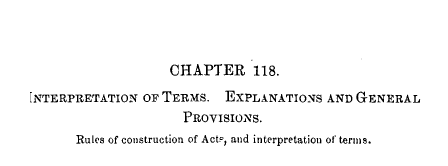




This was amended at some point between 1901 to 1903 under the new Interpretation Act to refer to the King and his heirs and successors.


This creates an interesting discussion point where both s.37 and s.38 essentially refer to the same legal concept and operate concurrently; however, s.37 is more specific in certain legal contexts. The definition of Queen's Counsel and King's Counsel can rely on both with an additional reference to the Demise of the Crown Act.


When do statutes become updated?

Because the Interpretation Act uses legal magic to declare that the word Queen actually means King as they both mean the Sovereign, it is not necessary in law to immediately update all Acts and Regulations. In a legal text, the reference to a male or female Monarch is essentially stylistic.  The King's Printer (formerly the Queen's Printer) will slowly make changes to legal texts when the Acts or Regulations are consolidated. Section 6 of the Queen's Printer Act allows for the King's Printer to make changes to the "form and style" of any Act or regulation without changing the substance. Obviously a good start would be to change the enabling statute for the King's Printer. This is what occurred both in the consolidations of 1903 and in 1952 after a change from a Queen to a King and King to a Queen.


The Legislature

All new bills introduced in the Legislative Assembly will now contain references to His Majesty. This is a legal requirement under section 2 of the Interpretation Act:
all Acts shall be enacted in the name of Her Majesty, and the enacting clause may be in the form following: “Her Majesty, by and with the advice and consent of the Legislative Assembly of New Brunswick, enacts as follows:


Many New Brunswickers may be unaware that bills also contain a reference to the year of the reign of the Sovereign. This is referred to as the Regnal Year and coincides when the Monarch succeeds to the Throne. Because the 1st session of the 60th Legislature has not been prorogued, it has continued for 3 Regnal Years of Queen Elizabeth. Any Bills introduced going forward will now have the 1st Regnal year of Charles III.

This will also impact the Chapters of the Annual Statutes of New Brunswick where any acts passed in 2022 in the fall will be physically separate from those Acts passed under the Queen's reign.


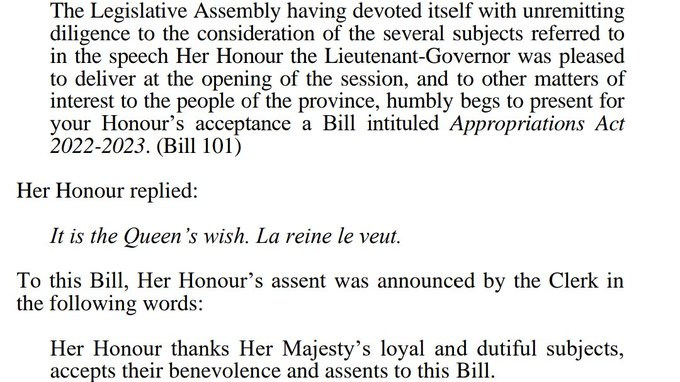
On June 10, 2022, the Lieutenant Governor of New Brunswick verbally granted Royal Assent to bill 101 using the form "it is the Queen's wish. La reine le veut". It will be quite some time before those words are said again in the Legislative Assembly. Going forward the Lieutenant Governor will use the words "it is the King's wish. Le roi le veut."
Conclusion


Most substantive changes related to the demise of the Crown happen automatically and today any potential negative legal impacts related to the death of the Sovereign are minimal. This means that a lot of the process in relation to the passing of Queen Elizabeth are commemorative or symbolic in nature. These are still important and confer meaning. We will learn in the coming days if the Governor General will proclaim a public holiday for a day to be observed for general mourning in relation to the National Ceremony of Mourning for Her Late Majesty. If such a proclamation occurs, it will automatically be a provincial holiday by virtue of the Interpretation Act. I cannot think of a more fitting intersection between ceremony and law.

Sunday, 22 May 2022

Bill 104: Clarification on the limits of the powers of a Medical Officer of Health & the Minister of Health


Clarification on the extent of  powers of Regional Medical Officers of Health, the Chief Medical Officer of Health and the Minister of Health.


Prior to the examination of  Bill 104 in Committee, I have a final observation that warrants either simply a clarification in the Assembly or an amendment to provide further clarity respecting the limits of the powers of the Regional Medical Officers of Health, the Chief Medical Officer of Health and the Minister of Health. The question is simple, what are the limits of the powers conferred to the Medical Officers of Health and the Minister of Health?  If the intention is for the powers of each officer holder to be constrained to the list of powers, a simple amendment to state that the powers are limited "with respect to the following matters". This would provide a clearer indication of roles and responsibilities to manage notifiable diseases. Alternatively, the Minister could indicate the legislative intent behind Bill 104 to resolve interpretative ambiguity.


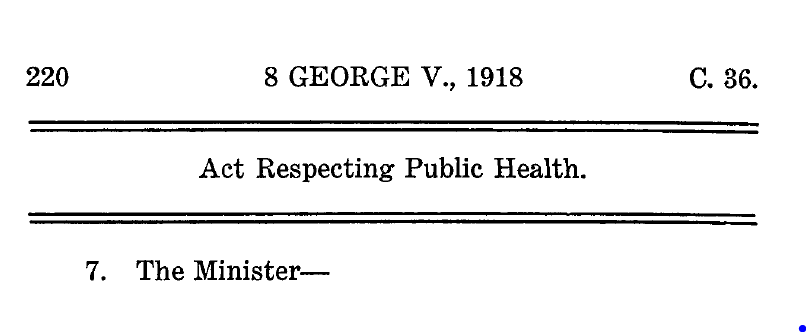
Bill 104 resolves many current deficiencies in the current Public Health Act. It is entirely appropriate to provide the Minister of Health specific authority to take certain measures to address public health in relation to Group I notifiable diseases. This restores a role that was gradually eliminated since the original modern 1918 Public Health Act. 


The advantage of the Minister of Health taking an action is that it creates a political linkage of accountability and responsibility back to the Legislative Assembly. Because the Minister rather than Cabinet is exercising the power, it does not contain the same limitations related to Cabinet confidentiality. This means that the Minister is able to provide an additional public rationale for decisions compared to decisions made at the Cabinet level.


However, there is still an issue related to the limits of each actor empowered to act for the purposes of public health.  There is a minor degree of interpretive ambiguity in the powers conferred to each position. This is because sections 33(4), 33.1(4) & & 33.2(4) state generally that an office holder has the power to to issue the following order: “An order may provide for any action that the medical officer of health [or other office holder] considers necessary”. 


This confuses a general standing power for each position to take any action to protect public health in the context of a notifiable disease but then applies specific examples of a non restrictive list. The extent of the powers are undefined where the list is merely illustrative.  By contrast, the specific powers afforded to the Federal cabinet under the Emergencies Act are limited. If an action cannot be placed under specific enumerated power, it does not exist.  The current wording of the powers provides a degree of flexibility, there is also the risk that a future government may misinterpret their powers beyond the scope of the act in a manner similar to treating the Emergency Measures Act as an enabling act and also confusing who should take responsibility for a specific public health measure.


An interpretative limitation is that an order under any Medical Officer of Health under section 33(4) cannot include class closure orders. This power is only conferred to the Minister of Health or in a more limited sense, the Chief Medical Officer of Health and is appropriate.  However there is still the possibility of administrative confusion surrounding the powers of a Medical Officer of Health (both regional and chief) using their powers under section 33(4) and the Minister’s powers under section 33.2(4) related to Group I notifiable diseases. This becomes further complicated when examining Cabinet’s remedial powers under s.68(nn) respecting the control of notifiable diseases . The concern is that there may be powers more appropriate for the Minister to use rather than a Medical Officer of Health. Alternatively, there may be circumstances where it is more suitable for Cabinet to utilize its powers.


 The reason why province wide application of certain powers requires political intervention is a function of Responsible Government. Province wide measures should draw the attention of the Minister and also the associated scrutiny and oversight of the Legislative Assembly. The nature of the drafting of s.33.2(4) raises the following question: does the government intend to grant the Minister of Health the power to impose a province wide quarantine or isolation travel registration scheme for persons entering the province? Similarly is the Assembly being asked to grant the power to the Minister of Health to have the power to impose vaccination passports or is the intention for this to be left with Cabinet? My assumption is no. However, the potential for overlapping powers can create a situation where responsibility and accountability becomes diffused and blurred.


There is less ambiguity for orders respecting premises, events or activities issued by the Chief Medical Officer of Health under 33.1(4). They are only directed to the owner or occupier of a premise, or a person responsible for an event. I view these as conferring general closure, or social distancing powers related to notifiable diseases. This addresses a deficiency in the current Health Hazard closure orders where they cannot be directed at human based diseases. Because, the Minister has the power to issue wider class orders, a qualified class order issued by the Chief Medical Officer of Health is limited it its interpretative powers.


A path forward?

A method to resolve this ambiguity is to amend the relevant sections to clarify that the examples are exhaustive rather than illustrative by stating that a Medical Officer of Health can take an action “with respect to the following matters” This amendment would clarify that a regional Medical Officer of Health does not have the authority to close public places, limit public gatherings or impose intraprovincial travel restrictions in the context of notifiable diseases for example.


A similar limitation on the Ministerial powers under section 33.2(4) would clarify that Cabinet still has remedial powers to make regulations for the control of notifiable diseases. This would ensure an understanding that the Minister of Heath would not have the authority to impose vaccination passports or a province wide travel registration scheme for the purposes of quarantine. These matters would be dealt with by Cabinet in a manner similar to the now repealed  Public Health Regulations.


For clarity, I view the Minister of Health or a Medical Officer of Health as having the power to impose mask wearing rules. This mask wearing power was already conferred via the power of a medical officer of health to order an individual to "conduct themselves in such a manner as not to expose another person to infection." via section 33(4)(d).  Cabinet however would still have an overriding power to regulate any matter respecting the control of a notifiable disease.


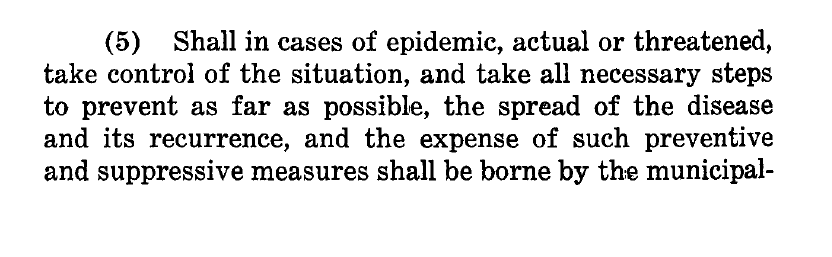
The source of this authority has generated significant recent commentary, especially in the context of masking wearing in schools. The power is not found under section 6 of the Public Health Act as those powers of a Medical Officer of Health only relate to Health Hazards which pursuant to the definition of  a Health Hazard under the act of the act are expressly not applied to human based diseases where a Health Hazard is a “ (b) a substance, thing or plant or animal other than a human”. 


Further I view that section 61.2 of the Public Health Act provides Medical Officers of Health a limited gap power to take certain district actions in relation to the absence of a clear legal authority elsewhere in the act. Since Medical Officers of Health already have specific powers related to the control of notifiable diseases under section 33(4), section 61.2 does not confer an additional or supplementary power with respect to notifiable diseases.


Vague laws are a friend to no one. Clarity on the limits of the powers afforded to Medical Officers of Health and the Minister of Health ensure greater compliance because of the clearer lines of accountability and responsibility. It is important to have these considerations known prior to the next wave of COVID-19. 


Suggested amendments


33(4) An order may provide for any action that the medical officer of health considers necessary with respect to the following matters to prevent, decrease or eliminate the risk to health presented by a notifiable disease  including requiring any person that the order states has or may have a notifiable disease or is or may be infected with an agent of a notifiable disease to do any or all of the following without delay:

(a)  isolate themselves and remain in isolation from other persons;
(b)  submit to an examination by a medical practitioner or a nurse practitioner and deliver to the medical officer of health a report by the medical practitioner or the nurse practitioner as to whether or not the person has a notifiable disease or is infected with an agent of a notifiable disease;
(c)  place themselves under the care and treatment of a medical practitioner or a nurse practitioner; or

(d)  conduct themselves in such a manner as not to expose another person to infection.


33.2 (4) An order may provide for any action that the Minister considers necessary with respect to the following matters to prevent, decrease or eliminate the risk to health presented by the Group I notifiable disease, including

(a)  directing the closure of a public place,
(b)  restricting or prohibiting public gatherings in a health region,
(c)  restricting travel to or from a health region, and
(d)  in the event that an order is directed to a class of individuals who have or may have a Group I notifiable disease or are or may be infected with an agent of a Group I notifiable disease, requiring each member of the class to do any or all of the following without delay:
( i) isolate themselves and remain in isolation from other persons;
( ii) submit to an examination by a medical practitioner or a nurse practitioner and deliver to the medical officer of health a report by the medical practitioner or the nurse practitioner as to whether or not the individual has a Group I notifiable disease or is infected with an agent of a Group I notifiable disease;
( iii) place themselves under the care and treatment of a medical practitioner or a nurse practitioner; or
( iv) conduct themselves in such a manner as not to expose another person to infection.

Saturday, 19 March 2022

The Legislative Assembly & Masking Wearing: The Public Galleries, Public Health & Parliamentary Privilege


A March 17 CBC New Brunswick News story reports that the Legislative Administration Committee (LAC) decided to continue restrictions on public attendance of Legislative Assembly proceedings. This is in part due to a decision to continue using the public galleries as an area to accommodate MLAs who choose to wear masks during the proceedings. Although the Legislative Administration Committee is the employer for employees who work in the Office of the Legislative Assembly and serves as the committee which oversees the administration of the Legislative Building, it does not have the legal authority to regulate or restrict access of MLAs to participate in a sitting of the legislative Assembly.]

Liberal Leader Roger Melanson said that part of the rationale in excluding the public is due to the current mask wearing rules which requires MLAs to wear masks on the floor of the Assembly but as CBC notes “ If they choose not to wear a mask, they have to sit upstairs in the public gallery, a space that's been used by some MLAs and ministers over the last two years to allow for distancing.” People’s Alliance Leader Kris Austin elaborated that the only exception for MLAs wearing masks while on the floor of the Assembly is if they are speaking during debate.


This requires a degree of clarification. Absent a decision of the Legislative Assembly, all mask wearing rules proposed by LAC for MLAs are merely voluntary guidelines and have no legal basis during a Parliamentary proceeding. As I said to the Telegraph Journal on October 26, 2021 in the context of requiring MLAs to be fully vaccinated to attend a sitting of the Legislative Assembly, Parliamentary Privilege confers the power to the Legislative Assembly to regulate their internal affairs: “MLAs have the privilege to be free from obstruction to attend a sitting of the House. And that individual right can only be overridden by the collective right of the Legislative Assembly to control its internal affairs.” Equally, a motion of the Legislative Assembly would be needed to require MLAs to wear masks in order to attend a sitting and only allow exemptions for removal when individuals are actively participating in debate.


An example I cite of MLAs imposing a restriction on who can attend and participate in legislative proceedings occurred in 1786 when the Assembly first met in Saint John. Under the Standing Rules at the time it was impermissible for MLAs to enter in the chamber or participate in debate while wearing a hat. Requiring an MLA to wear a mask to participate in a sitting is no different. LAC would not have the jurisdiction to prevent an MLA from accessing the House or participating within. Normal Public Health rules do not automatically apply to MLAs in the context of a parliamentary proceeding, it is for the Assembly to decide how to limit access to MLAs. In the absence of the Assembly itself making a decision, the exclusion of the public is an unfortunate incidental consequence to avoid infringing on the individual rights of MLAs.


This aspect of Parliamentary Privilege may be misunderstood by some resulting in confusion. The Supreme Court of Canada has recognized that Legislative Assemblies have the exclusive right to control access to the Public Galleries. This constitutional right to control their internal proceedings is not subject to the Charter as one element of the constitution cannot be used to override another. A common example is that the mandatory retirement of Senators at age 75 is exempt from s.15 Charter equality provisions related to discrimination on the basis of age. Further it is for the Speaker acting on behalf of the Assembly to determine whether the public can attend proceedings of the Assembly. Although it may seem contrary to modern democratic norms, the public has no right of access to attend a proceeding. The Assembly or LAC, via its delegated powers, can exclude public access to proceedings or the building for any reason. In this case the rationale is not necessarily in the name of public health but to ensure that the individual privileges of MLAs who choose not to wear masks in the House are not infringed.


Now there are several means to resolve this situation to protect MLAs by wearing masks and also allow for public access to the galleries that end in the same result: requiring MLAs to wear masks except for when activity participating in debate:


The motion: To require all MLAs to wear a mask while attending a proceeding of the Legislative Assembly or its committees with the exception of when speaking during debate.


Option 1: With Leave


With unanimous consent of all MLAs present, an MLA can move a mask motion without notice.

Option 2: A Government Motion


After 2 days notice, A member of the Government can move a mask wearing motion under Orders of the Day.


Option 3: An Opposition Members’ Motion


If required notice is provided an opposition can move a mask wearing motion during Opposition Members’ Business on Thursday.


Option 4: A Government Backbencher moving a motion

After the required notice, a Government Private Member can move a mask wearing motion during Orders of the Day subject to being called by the Government House Leader.


Based on the close confines of the Legislative Assembly chamber, it is understandable that despite the relaxation of Public Health Measures, that MLAs may wish to take additional temporary precautions. It would be strongly recommended that any mask wearing motion have a clear end date to prompt a reassessment. Absent a clear end date, a mask wearing motion will cease to have effect on prorogation which may occur in the Spring to accompany a new Speech from the Throne.


Presently there are no mask wearing ‘rules’ in the Assembly for MLAs participating during a Chamber proceeding, under Parliamentary law they are only voluntary. There are presently no restrictions or consequences for those MLAs who choose not to wear a mask. MLAs who wish to ensure additional steps are taken to protect themselves and employees of the Legislative Assembly should strongly pass a motion to require the wearing of masks during a sitting of the Legislative Assembly or its Committees. By doing so, it would then allow for members of the public to once again return to the ‘People’s House”.