Clarification on the extent of powers of Regional Medical Officers of Health, the Chief Medical Officer of Health and the Minister of Health.
Prior to the examination of Bill 104 in Committee, I have a final observation that warrants either simply a clarification in the Assembly or an amendment to provide further clarity respecting the limits of the powers of the Regional Medical Officers of Health, the Chief Medical Officer of Health and the Minister of Health. The question is simple, what are the limits of the powers conferred to the Medical Officers of Health and the Minister of Health? If the intention is for the powers of each officer holder to be constrained to the list of powers, a simple amendment to state that the powers are limited "with respect to the following matters". This would provide a clearer indication of roles and responsibilities to manage notifiable diseases. Alternatively, the Minister could indicate the legislative intent behind Bill 104 to resolve interpretative ambiguity.
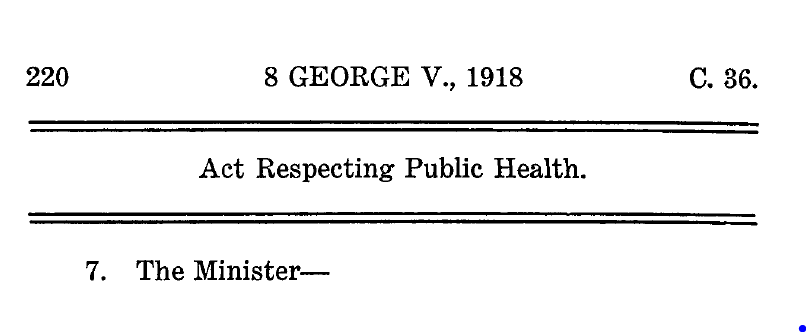
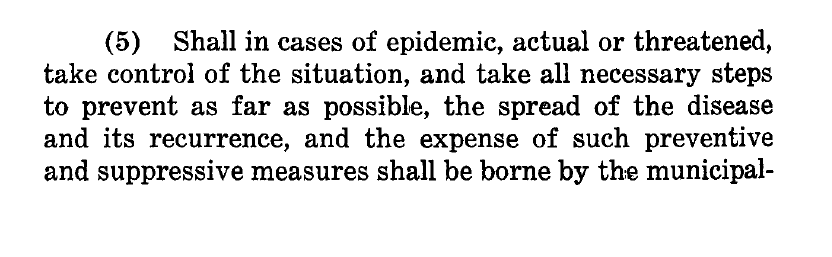
Bill 104 resolves many current deficiencies in the current Public Health Act. It is entirely appropriate to provide the Minister of Health specific authority to take certain measures to address public health in relation to Group I notifiable diseases. This restores a role that was gradually eliminated since the original modern 1918 Public Health Act.

The advantage of the Minister of Health taking an action is that it creates a political linkage of accountability and responsibility back to the Legislative Assembly. Because the Minister rather than Cabinet is exercising the power, it does not contain the same limitations related to Cabinet confidentiality. This means that the Minister is able to provide an additional public rationale for decisions compared to decisions made at the Cabinet level.
However, there is still an issue related to the limits of each actor empowered to act for the purposes of public health. There is a minor degree of interpretive ambiguity in the powers conferred to each position. This is because sections 33(4), 33.1(4) & & 33.2(4) state generally that an office holder has the power to to issue the following order: “An order may provide for any action that the medical officer of health [or other office holder] considers necessary”.
This confuses a general standing power for each position to take any action to protect public health in the context of a notifiable disease but then applies specific examples of a non restrictive list. The extent of the powers are undefined where the list is merely illustrative. By contrast, the specific powers afforded to the Federal cabinet under the Emergencies Act are limited. If an action cannot be placed under specific enumerated power, it does not exist. The current wording of the powers provides a degree of flexibility, there is also the risk that a future government may misinterpret their powers beyond the scope of the act in a manner similar to treating the Emergency Measures Act as an enabling act and also confusing who should take responsibility for a specific public health measure.
An interpretative limitation is that an order under any Medical Officer of Health under section 33(4) cannot include class closure orders. This power is only conferred to the Minister of Health or in a more limited sense, the Chief Medical Officer of Health and is appropriate. However there is still the possibility of administrative confusion surrounding the powers of a Medical Officer of Health (both regional and chief) using their powers under section 33(4) and the Minister’s powers under section 33.2(4) related to Group I notifiable diseases. This becomes further complicated when examining Cabinet’s remedial powers under s.68(nn) respecting the control of notifiable diseases . The concern is that there may be powers more appropriate for the Minister to use rather than a Medical Officer of Health. Alternatively, there may be circumstances where it is more suitable for Cabinet to utilize its powers.
The reason why province wide application of certain powers requires political intervention is a function of Responsible Government. Province wide measures should draw the attention of the Minister and also the associated scrutiny and oversight of the Legislative Assembly. The nature of the drafting of s.33.2(4) raises the following question: does the government intend to grant the Minister of Health the power to impose a province wide quarantine or isolation travel registration scheme for persons entering the province? Similarly is the Assembly being asked to grant the power to the Minister of Health to have the power to impose vaccination passports or is the intention for this to be left with Cabinet? My assumption is no. However, the potential for overlapping powers can create a situation where responsibility and accountability becomes diffused and blurred.
There is less ambiguity for orders respecting premises, events or activities issued by the Chief Medical Officer of Health under 33.1(4). They are only directed to the owner or occupier of a premise, or a person responsible for an event. I view these as conferring general closure, or social distancing powers related to notifiable diseases. This addresses a deficiency in the current Health Hazard closure orders where they cannot be directed at human based diseases. Because, the Minister has the power to issue wider class orders, a qualified class order issued by the Chief Medical Officer of Health is limited it its interpretative powers.
A path forward?
A method to resolve this ambiguity is to amend the relevant sections to clarify that the examples are exhaustive rather than illustrative by stating that a Medical Officer of Health can take an action “with respect to the following matters” This amendment would clarify that a regional Medical Officer of Health does not have the authority to close public places, limit public gatherings or impose intraprovincial travel restrictions in the context of notifiable diseases for example.
A similar limitation on the Ministerial powers under section 33.2(4) would clarify that Cabinet still has remedial powers to make regulations for the control of notifiable diseases. This would ensure an understanding that the Minister of Heath would not have the authority to impose vaccination passports or a province wide travel registration scheme for the purposes of quarantine. These matters would be dealt with by Cabinet in a manner similar to the now repealed Public Health Regulations.
For clarity, I view the Minister of Health or a Medical Officer of Health as having the power to impose mask wearing rules. This mask wearing power was already conferred via the power of a medical officer of health to order an individual to "conduct themselves in such a manner as not to expose another person to infection." via section 33(4)(d). Cabinet however would still have an overriding power to regulate any matter respecting the control of a notifiable disease.
The source of this authority has generated significant recent commentary, especially in the context of masking wearing in schools. The power is not found under section 6 of the Public Health Act as those powers of a Medical Officer of Health only relate to Health Hazards which pursuant to the definition of a Health Hazard under the act of the act are expressly not applied to human based diseases where a Health Hazard is a “ (b) a substance, thing or plant or animal other than a human”.
Further I view that section 61.2 of the Public Health Act provides Medical Officers of Health a limited gap power to take certain district actions in relation to the absence of a clear legal authority elsewhere in the act. Since Medical Officers of Health already have specific powers related to the control of notifiable diseases under section 33(4), section 61.2 does not confer an additional or supplementary power with respect to notifiable diseases.
Vague laws are a friend to no one. Clarity on the limits of the powers afforded to Medical Officers of Health and the Minister of Health ensure greater compliance because of the clearer lines of accountability and responsibility. It is important to have these considerations known prior to the next wave of COVID-19.
Suggested amendments
33(4) An order may provide for any action that the medical officer of health considers necessary with respect to the following matters to prevent, decrease or eliminate the risk to health presented by a notifiable disease including requiring any person that the order states has or may have a notifiable disease or is or may be infected with an agent of a notifiable disease to do any or all of the following without delay:
33.2 (4) An order may provide for any action that the Minister considers necessary with respect to the following matters to prevent, decrease or eliminate the risk to health presented by the Group I notifiable disease, including

